From Korea
Banning Advanced Instruction, but Not at Private Academies
In March 2018, South Korea banned after-school English classes for first- and second-grade students at elementary schools.
In South Korea, English is introduced as a regular school subject in third grade. Teaching English to first- and second-graders was therefore considered advanced instruction, meaning teaching material ahead of the official curriculum.
The ban was based on the Special Act on the Promotion of Normalization of Public Education and Regulation of Pre-Curriculum Education, enacted in 2014. It is commonly known in Korea as the Public Education Normalization Act or the Anti-Advanced Learning Act.
But while schools were prohibited from offering these after-school English classes, private English academies could continue teaching children of the same age. The law restricted advanced instruction in schools but did not prohibit it at private academies.
After-school English classes at public schools were often cheaper than those offered by private academies. Critics worried that removing these classes would not stop children from learning English early. Instead, families would simply turn to private academies, increasing the financial burden on parents.
In March 2019, the National Assembly amended the law to allow after-school English classes for first- and second-graders again.[1]
The classes had been banned in schools for about a year, but private academies had been free to offer them throughout that period.
This case led me to take a closer look at the Public Education Normalization Act.
The law prohibited schools from teaching or assessing students on material beyond the prescribed curriculum. For private academies, however, it only prohibited advertisements that encouraged advanced learning. Even that provision had no separate penalty for violations.
In other words, the law placed restrictions on public education while allowing advanced instruction to continue in the private education sector.
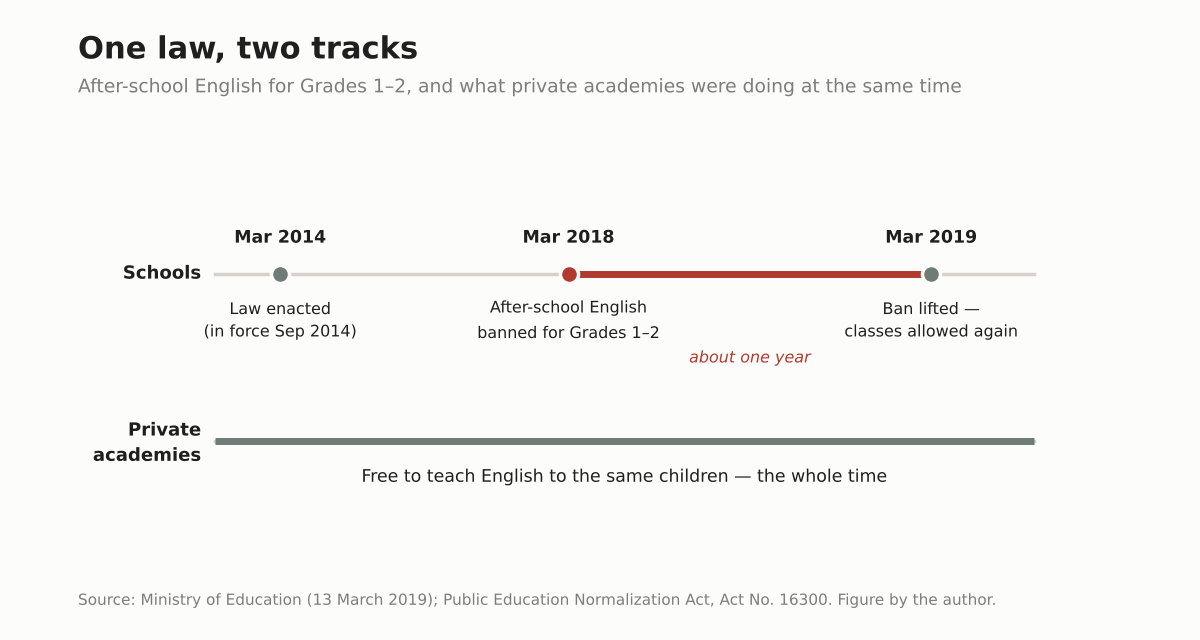
Figure 1. Changes in South Korea’s after-school English education policy, 2014–2019.
1. A Law That Prohibits Schools from Teaching Ahead of the Curriculum
The Public Education Normalization Act was enacted on March 11, 2014, and took effect on September 12 of the same year.[2]
The law distinguishes between advance instruction and advance learning.
Advance instruction refers to educational institutions teaching material ahead of the prescribed curriculum. Advance learning refers to students studying material before it is scheduled to be taught.
If a student studies next year’s mathematics at home, or parents teach their child material in advance, the law does not directly prohibit it. The law primarily regulates educational activities within schools.
Under Article 8(1), schools cannot offer instruction that goes beyond their established school curriculum. This restriction generally applies not only to regular classes but also to after-school programs.
Article 8(3) also prohibits schools from including questions that exceed the scope and level of what has been taught in written assessments or performance-based assessments. The same restriction applies to school competitions.
The law even includes an additional provision stating that teachers must not conduct lessons on the assumption that students have already learned the material in advance, in order to protect students’ right to learn.
In other words, teachers cannot skip explanations or move through the curriculum faster simply because some students have already studied the material.
The law prohibits schools from teaching ahead of the curriculum and from assuming that students have already learned what they are supposed to be taught.
However, these restrictions do not apply to every educational activity. The law provides exceptions for gifted education, programs for students eligible for early grade advancement or early graduation, physical education, the arts, and certain specialized subjects.
The law also specifies what happens when schools violate these rules.
Under Article 14, the Minister of Education or a superintendent of education may order a school that violates the law to make corrections or changes.
If the school fails to comply without a legitimate reason, disciplinary proceedings may be requested. In serious cases, additional measures may include suspending or reducing financial support, reducing student enrollment quotas, or suspending student admissions.
Of course, violating the law does not automatically result in these penalties. Procedures involving corrective orders and failure to comply with them must first be followed.
This means that when schools organize their curricula and prepare assessment plans, they must check the scope and level of material they are permitted to teach at each grade level.
2. What Rules Applied to Private Academies?
The Public Education Normalization Act contains relatively few provisions that directly regulate private academies (hagwons).
A closer look at the law shows that Article 8(4) prohibits private academies from advertising in ways that encourage advance learning. However, it does not prohibit advance instruction itself.
In other words, the law does not prevent private academies from teaching middle school mathematics to elementary school students or high school material to middle school students. The academies could teach ahead of the curriculum, but they were not allowed to advertise in ways that encouraged students to study ahead.
Even this advertising restriction, however, came without a separate penalty provision.
When schools violated the law, authorities could issue corrective orders. If schools failed to comply, they could face disciplinary measures or reductions in financial support.
Private academies, on the other hand, could not be fined or ordered to suspend instruction under this law simply for running advertisements that encouraged advance learning.
In April 2014, before the law even took effect, the head of a teachers’ organization in Daegu criticized the provision as “a declaratory ban on advertising without any penalties.”[3]
The same law therefore treated schools and private academies quite differently.
For schools, it established restrictions on curriculum instruction and assessment, along with measures for violations. For private academies, it prohibited advertising that encouraged advance learning but provided no separate penalties for violations. The academies remained free to teach material ahead of the school curriculum.
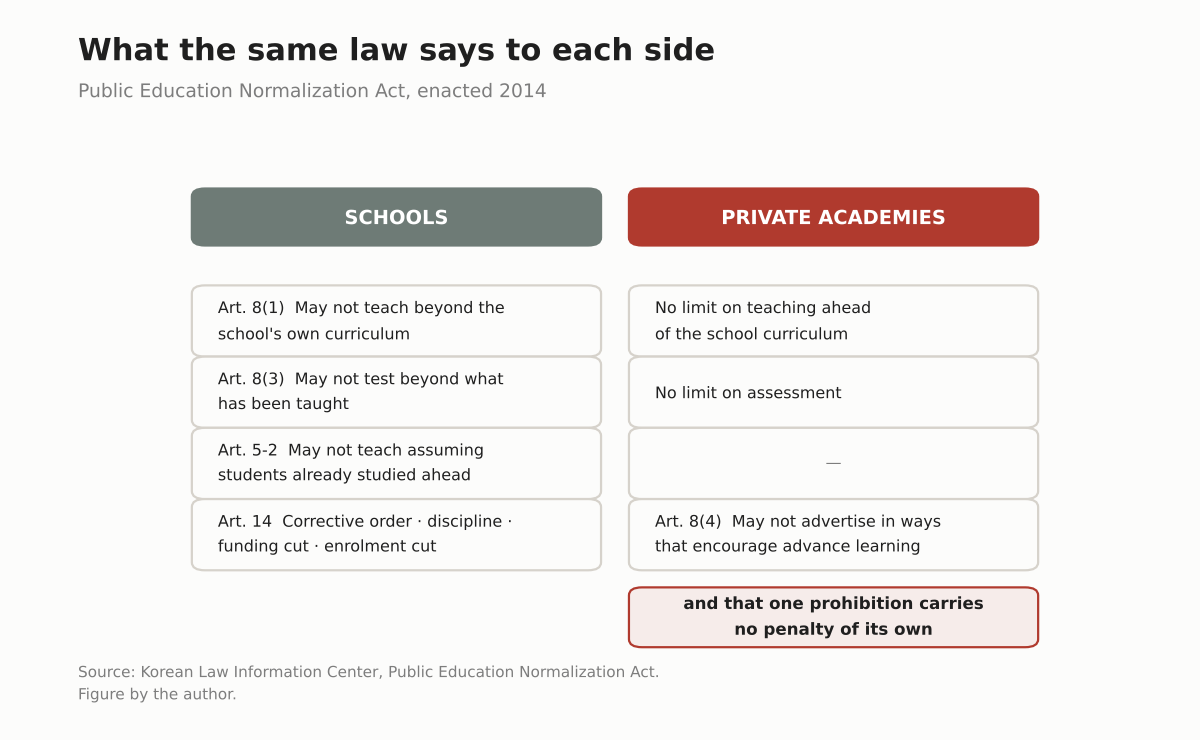
Figure 2. Comparison of regulations for schools and private academies under South Korea’s Public Education Normalization Act.
3. The Government Continued to Monitor Academy Advertisements
The lack of penalties did not mean that the government stopped monitoring private academy advertisements.
In 2016, the Ministry of Education worked with the Korea Internet Advertising Foundation to review academy websites and banner advertisements. The review identified 341 cases of private education marketing that exploited the Free Semester Program and advertisements that encouraged advance learning.[4]
Around the same time, the Korea Fair Trade Commission requested voluntary corrections in 130 cases of false or exaggerated advertising by private academies.
However, the findings of the two agencies need to be distinguished. False or exaggerated advertising could be penalized under other laws, but there was no separate legal basis for penalizing advertisements simply because they encouraged advance learning.
Monitoring continued in the following years.
According to data released during the 2020 parliamentary audit, the 17 metropolitan and provincial offices of education across South Korea identified a total of 31 cases of illegal advertisements encouraging advance learning over a three-year period.[5]
The Ministry of Education issued administrative guidance requesting the removal of these advertisements. It also separately investigated whether the academies had violated the laws governing private educational institutions.
There were also attempts to introduce penalties for violations of the advertising ban under the Public Education Normalization Act.
In 2024, a bill was introduced that would impose administrative fines on private academies for advertisements encouraging advance learning. Another proposal sought to directly restrict advance instruction at private academies and allow authorities to suspend instruction for violations.[6][7]
However, as of October 2026, these proposals had not been incorporated into the law.
Rather than directly restricting advance instruction at private academies, the government continued to rely on advertising monitoring and administrative guidance.
4. How Did Private Education Spending Change?
Twelve years have passed since the Public Education Normalization Act took effect.
How has private education spending changed during that time?
In 2025, South Korean elementary, middle, and high school students spent approximately 27.5 trillion won on private education. This was a decrease of 1.7 trillion won, or 5.7%, from 2024.[8]
However, the picture looks different when we focus only on students who actually participated in private education.
In 2025, the average monthly spending per student participating in private education was 604,000 won, an increase of 2.0% from the previous year.
In other words, while total private education spending declined, the average amount spent on students receiving private education actually increased.
Two things explain the gap. The participation rate itself fell to 75.7%, down 4.3 percentage points from 2024. And there are simply fewer students: the elementary, middle and high school population dropped from about 5.88 million in 2016 to about 4.99 million in 2025, a decline of roughly 15%. The total went down because there were fewer people paying. What each participating family pays went up.
Participation rates also varied by school level.
Elementary school students had the highest participation rate, at 84.4%, compared with 73.0% in middle school and 63.0% in high school. They also accounted for the largest share of total private education spending, at 12.2 trillion won.
This means that more than eight out of ten elementary school students received some form of private education.
These figures show that even 12 years after the law prohibited schools from teaching ahead of the curriculum, many students continue to receive education outside the public school system.
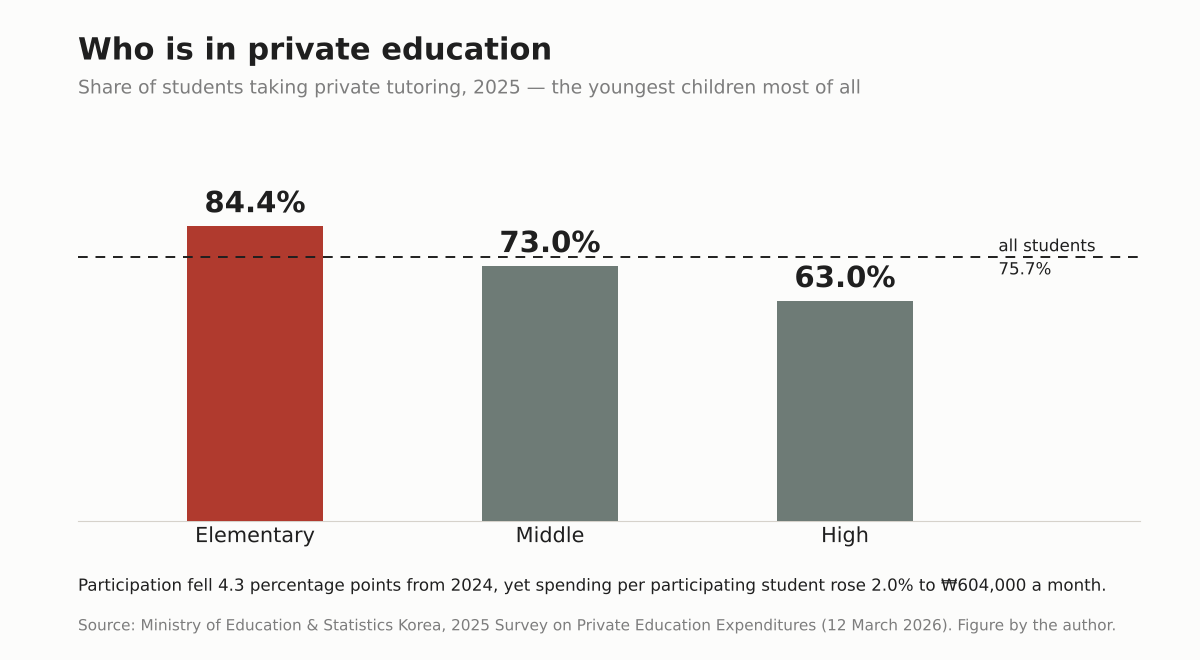
Figure 3. Private education participation rates by school level in South Korea, 2025. Source: Ministry of Education & Statistics Korea, 2025 Survey on Private Education Expenditures (12 March 2026).
5. Can Banning Advance Instruction in Schools Alone Make a Difference?
What I find most puzzling about the Public Education Normalization Act is that it applies different rules to schools and private academies.
Schools cannot teach material ahead of the curriculum, but private academies can. When students are already learning next year’s material at private academies, I wonder how effective it can be to prohibit advance instruction only in schools.
The same issue arose with after-school English classes for first- and second-grade elementary school students, as discussed earlier. Schools were prohibited from offering these classes, while private academies could continue teaching English. Eventually, concerns that the ban could increase the burden of private education led the government to allow schools to offer English classes again.
Article 5-2, added in 2016, is also worth revisiting.
Teachers must not conduct lessons on the assumption that students have already learned the material in advance.
I understand the purpose of this provision. Students who have not attended private academies should still be able to follow lessons at school.
But as long as private academies continue to offer advance instruction, the gap between students who have studied ahead and those who have not will remain. Prohibiting advance instruction in schools does not stop students from studying ahead outside school.
Of course, requiring schools to follow the prescribed curriculum has value in itself. If schools began treating advance learning as the norm and moving through the curriculum faster, students who do not attend private academies could be placed at an even greater disadvantage.
However, if the law aims not only to ensure that schools follow the curriculum but also to reduce practices that encourage advance learning, we need to ask whether the current approach is enough.
Schools and private academies serve different purposes and have different legal roles. This does not mean they must be subject to identical regulations.
But whether restricting what schools can teach is enough to reduce competition over advance learning is a separate question.
Schools are prohibited from teaching ahead of the curriculum, while private academies remain free to do so. Students who have already learned the material then return to their regular classrooms.
Twelve years after the law was enacted, this basic structure remains largely unchanged.
The Public Education Normalization Act may play an important role in keeping schools aligned with the prescribed curriculum. But whether it can also address the competition to learn ahead of the curriculum outside school remains an open question.
References
[1] Ministry of Education, “After-School English Classes Allowed for First- and Second-Grade Elementary Students and Installation of Air Purification Systems in Classrooms to Protect Students’ Health,” March 13, 2019; Korean Law Information Center, Public Education Normalization Act, Act No. 16300 (March 26, 2019).
[2] Korean Law Information Center, Special Act on the Promotion of Public Education Normalization and Regulation on Pre-Curriculum Education, enacted March 11, 2014, effective September 12, 2014, Act No. 20722 (January 31, 2025).
[3] Maeil Shinmun, report on the proposed Enforcement Decree of the Public Education Normalization Act, April 18, 2014.
[4] Ministry of Education and Korea Fair Trade Commission, “Results of the Investigation into Exaggerated and False Advertising by Private Academies,” August 25, 2016.
[5] Daehak Journal, “[2020 Parliamentary Audit] Only 31 Cases of Illegal Advertisements Encouraging Advance Learning Detected in Three Years,” October 19, 2020.
[6] Financial News, “From Medical School Prep Classes for Elementary Students to Early Elementary Education for Preschoolers: Lawmakers Move to Regulate Private Education,” August 28, 2024.
[7] Education Press [Chang], “Bill Proposed to Suspend Instruction at Private Academies That Continue Advance Teaching: The ‘Elementary Medical School Prep Class Prevention Act,’” September 30, 2024.
[8] Ministry of Education and Statistics Korea, “2025 Survey on Private Education Expenditures for Elementary, Middle, and High School Students,” March 12, 2026.