From Korea
Testing Three AI Detectors on Primary-School Writing
This autumn I gave my fifth-grade class a persuasive writing assignment.
The children wrote in pencil, in the classroom. None of them used generative AI.
Looking through the essays afterwards, I began to wonder what an AI detector would make of them.
Most arguments about AI detectors start from a situation where nobody can know whether a student used AI. A teacher puts a suspicious essay into a detector, the detector returns a verdict, and there is no way to check whether the verdict is right.
This time I had essays I knew the students had written themselves. So I typed the handwriting up as it was and put it through three AI detectors.
The results were not what I expected.
One detector judged 15 of the 41 student essays to have been written by AI. All 15 came back as 100% AI.
That same detector states in its official documentation that its false-positive rate is below 0.2%.[1]
1. Forty-one student essays and twenty AI essays
The students completed two writing assignments.
The first asked them to argue why people should read more books. The second asked them to write to the principal proposing a better way to use the school library.
I collected 20 essays from the first assignment and 21 from the second. Forty-one in total, all handwritten.
Testing student essays alone would not tell me much about how the detectors perform. If all 41 came back as human-written, I would not know whether the detectors had told humans and AI apart correctly, or whether they simply fail to find AI writing at all.
So I also produced AI essays to compare against.
I gave the same two prompts to a generative AI exactly as the students had received them, and generated 20 essays, 10 per assignment. I did not ask it to write like a primary-school student. I had in mind a student who types the assignment into a chatbot and submits whatever comes back.
I did try to match the lengths as closely as I could. GPTZero states in its official FAQ that accuracy increases as the submitted text gets longer.[2]
I adjusted the AI essays’ length over three passes. On the first assignment the student essays averaged 693 characters and the AI essays 645. On the second the figures were 629 and 600. Not identical, but closer.
The students’ handwriting was transcribed exactly as written, including spelling and spacing errors. I did not polish sentences or change wording, and I checked the typed text against the originals.
I then shuffled the prepared essays within each assignment and numbered them. While recording results I did not check whether a given number was a student essay or an AI one.
Testing was carried out on 12 and 13 October 2026, using GPTZero, Copyleaks and ZeroGPT, all in their free web versions.
For each essay I recorded the verdict the tool displayed on screen — whether it judged the text human-written, AI-written, or a mixture of the two.
I did not compare the percentages the detectors show against each other.
GPTZero reports which of three categories — human, AI, or mixed — a text is most likely to belong to.[3] Copyleaks shows the proportion of the text it believes AI produced, and ZeroGPT shows a detection score for AI writing patterns.
All three appear as percentages, but they do not mean the same thing. So I compared the detectors on their final verdicts. Where a tool returned AI or mixed, I counted that as the detector pointing to AI use.
2. Detector errors have been reported before
Several studies have already examined how reliable AI detectors are.
In 2023 Weber-Wulff and colleagues applied 14 AI detectors to 54 test cases.[4]
They concluded that the detectors of the time were neither accurate nor reliable enough, and should not be used in academic settings.
False-positive rates varied widely between tools. Turnitin was at 0% and GPTZero at 50%. A false positive here means human-written text wrongly judged to be AI-generated.
Interestingly, ZeroGPT produced no false positives. That matches what I found this time.
GPTZero, by contrast, was the tool with the most false positives then. My results point almost the opposite way. The versions and the test material are both different between 2023 and now, so the two cannot be compared directly.
The same year, Liang and colleagues also studied detector errors.[5]
Using seven AI detectors, they tested 91 TOEFL essays written by non-native English speakers and 88 essays by American eighth-graders.
The American eighth-graders’ essays were classified correctly most of the time. The TOEFL essays were misclassified as AI-written at an average rate of 61%. Of the 91, 89 were flagged as AI by at least one of the seven detectors.
The researchers then rewrote the TOEFL essays with richer vocabulary and more varied sentence structure. The false-positive rate fell from 61% to 12%.
The authorship had not changed. Only the manner of expression had, and the detection results changed a great deal.
The researchers suggested that detectors may respond to the predictability of the sentences or to limited linguistic expression, rather than to who actually wrote the text.
Primary-school writing is worth thinking about in this light. Children are still learning to write, so they often use short, simple sentences and repeat similar expressions. These characteristics could plausibly affect detection results.
There has also been recent work on Copyleaks specifically.
In 2026 Van Vlasselaer and colleagues evaluated four AI detectors using 160 academic papers.[6]
Forty of these were master’s theses written before 2019 — text produced before ChatGPT was released, so it can be confirmed that generative AI did not write it.
Copyleaks judged all 40 to be human-written. There was not a single false positive.
But a detector that was accurate on academic papers written in English by adults might not behave the same way on primary-school writing, or in Korean.
3. The three detectors gave very different results
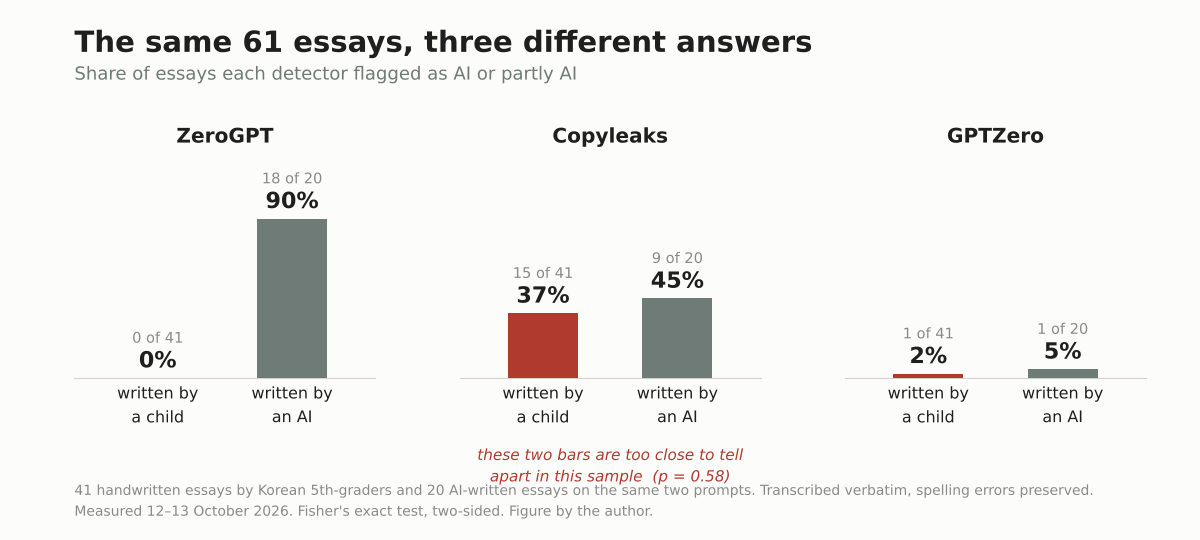
Figure 1. False-positive rate on student essays and detection rate on AI essays, by detector.
ZeroGPT first.
It judged all 41 student essays to be human-written. No AI verdicts, and no partly-AI verdicts either.
Of the 20 AI essays it found 18. Nine it judged AI-written and the other nine partly AI-written.
On this material it was the best of the three.
GPTZero was different.
It judged 1 of the 41 student essays to involve AI. There were almost no false positives. But it also found only 1 of the 20 AI essays. The other 19 it judged human-written.
Looking only at the student essays, it could pass for a fairly accurate detector. In fact it also let through nearly every essay that AI had written.
Copyleaks last.
Its results were the most unexpected.
It judged 15 of the 41 student essays to have been written by AI. Not a verdict of partial AI use — all 15 were displayed on screen as 100% AI.
The same detector found only 9 of the 20 AI essays.
The results can be summarised as follows.
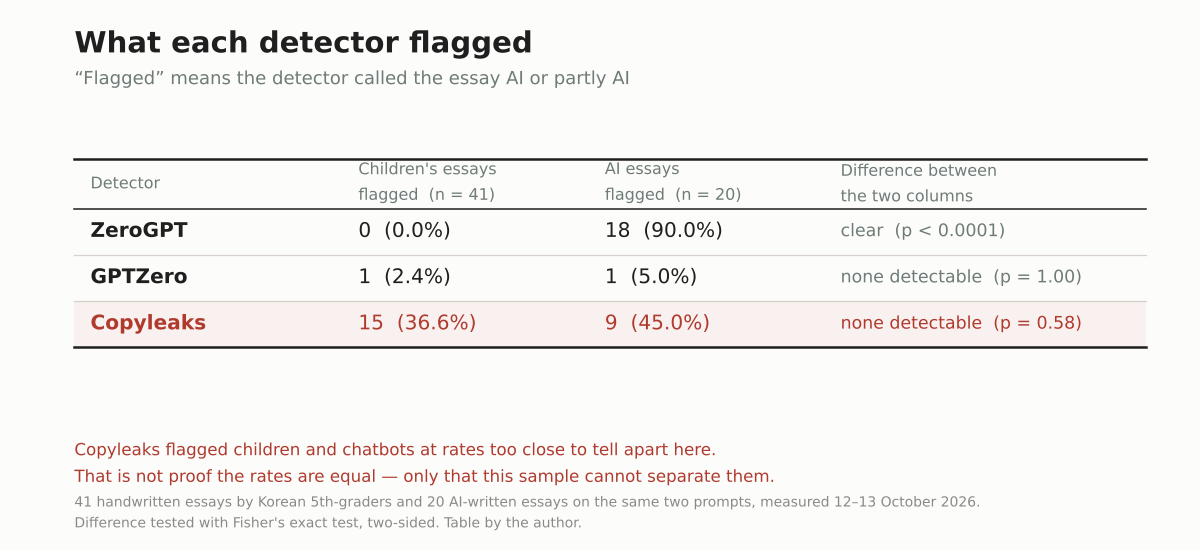
Table 1. The same counts as Figure 1, with a test of whether each detector’s two columns can be told apart.
Verdicts of partial or mixed AI use were counted as detections.
Copyleaks judged 36.6% of the student essays to be AI, and found 45% of the actual AI essays. The gap between the two rates is about 8.4 percentage points.
Fisher’s exact test found no statistically significant difference between them (two-sided, p = 0.584).
Not being statistically significant does not mean the two rates are equal. The sample is small, so a real difference might simply have gone undetected.
What this material does show is that it is hard to say Copyleaks distinguished student writing from AI writing properly, because the rate at which it found genuine AI essays and the rate at which it wrongly flagged human-written ones were not very different.
4. Copyleaks publishes a false-positive rate below 0.2%
Copyleaks publishes specific figures for its detector’s accuracy.
Its product page shows 99% accuracy backed by independent third-party studies, and an industry-low 0.03% false-positive rate.[7]
A separate FAQ document states that the false-positive rate is below 0.2%.[1]
If those numbers hold, it should be very rare for text a person wrote themselves to be wrongly judged AI. In my students’ essays, 15 of 41 were misclassified.
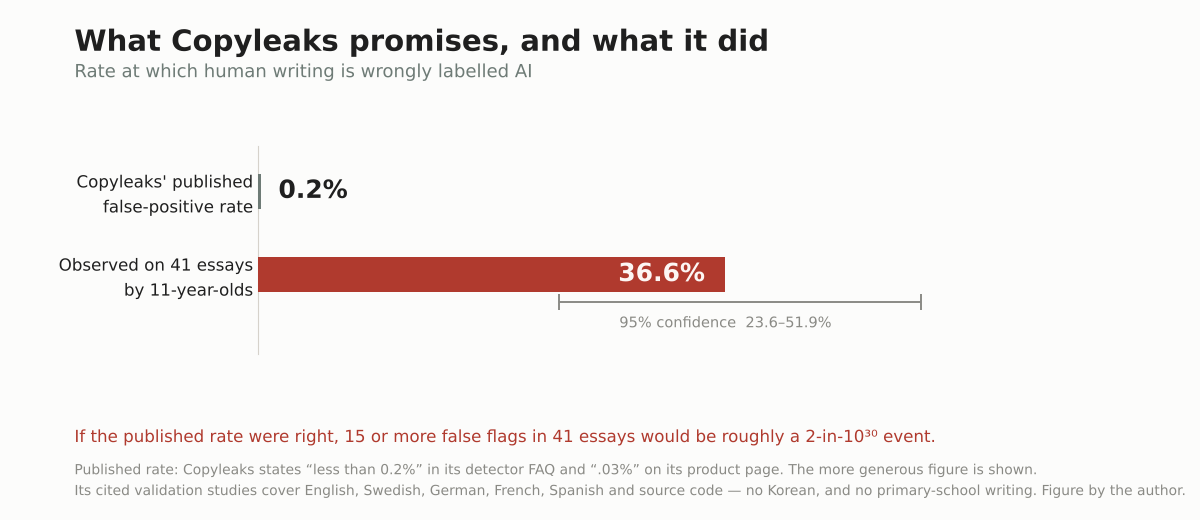
Figure 2. Copyleaks’ published false-positive rate against the rate observed on Korean fifth-graders’ essays.
The false-positive rate was 36.6%.
The 95% Wilson confidence interval ran from 23.6% to 51.9%. That interval treats the 41 essays as independent observations, so it is best read as indicative.
Compared against 0.2%, that is roughly 183 times higher.
If each essay’s verdict were independent and the true false-positive rate were 0.2%, the probability of 15 or more of 41 being misclassified would be about 2×10⁻³⁰.
But that calculation assumes the published false-positive rate applies to my students’ essays as they are. Whether that assumption holds was the first thing to check.
So I looked at the material Copyleaks offers as the basis for its accuracy.
The company maintains a page summarising a number of external studies.[8] These cover news articles, academic essays, scientific papers, books and university student assignments. Some of the studies used languages other than English, including German, French and Spanish.
But in the list of studies I could find, there was no validation using Korean primary-school writing.
The product page says the detector supports more than 30 languages. Korean was not among the languages in the list giving specific per-language accuracy figures.[7]
That does not mean Korean is unsupported. It means it was difficult to establish how accurate the detector is in Korean, and particularly on the short texts primary-school students write.
Length differed too.
Copyleaks recommends in its FAQ that texts of 350 words or more be submitted for accurate results.[1]
The student essays I tested averaged roughly 600 to 700 characters. That is a different quantity of text from an adult academic paper or a long essay.
In short, the figure Copyleaks publishes and the figure I observed were measured under different conditions. The language differs, and so do the length and type of the text and the age of the writer.
A detector with almost no false positives on academic papers written in English by adults is not thereby guaranteed to behave the same way on short Korean texts written by primary-school children.
I cannot conclude that the false-positive rate Copyleaks publishes is wrong. What I can say is that the figure needs to be read together with the material it was measured on, and with whether that material resembles the setting where the tool will actually be used.
In my students’ essays, the result was considerably different from the published figure.
5. The essay two detectors both called AI
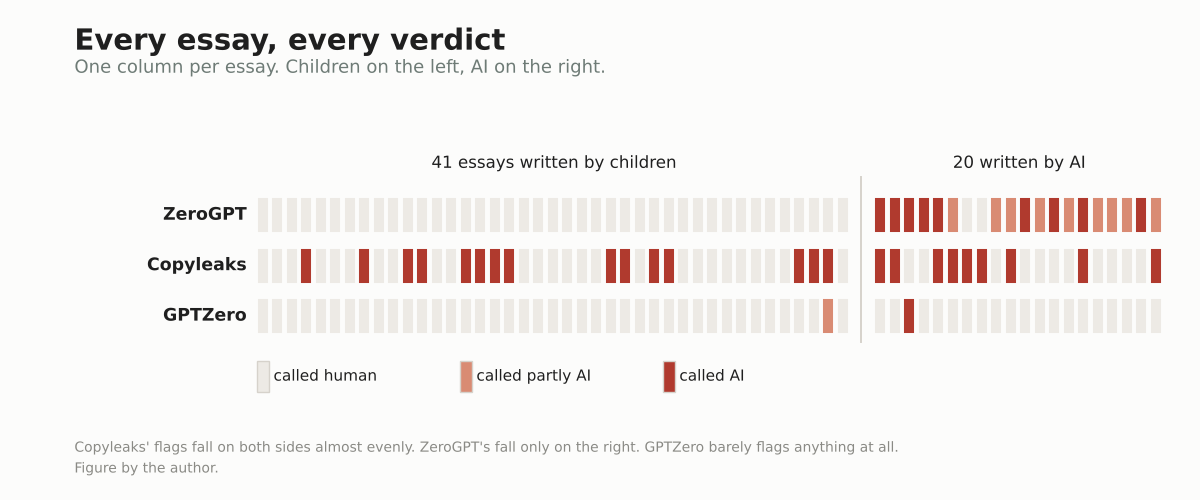
Figure 3. All three detectors’ verdicts on 41 student essays and 20 AI essays.
The figure sets out all 61 verdicts at once.
ZeroGPT’s flags are concentrated almost entirely on the AI essays. GPTZero passed nearly everything. Copyleaks returned AI verdicts at a similar rate on both sides.
One essay stands out.
Number 59 was a 924-character persuasive essay, the longest any student in the class wrote.
GPTZero put the probability that it was a mixture of human and AI writing at 99%. That was the highest mixed score anywhere in the 61 essays I tested.
Copyleaks judged it 100% AI.
Two detectors both returned verdicts indicating AI involvement.
But the student wrote that essay in my classroom. I watched them write it in pencil.
What if I had not seen it being written?
With two detectors both showing a high likelihood of AI use, I might well have asked the student about it.
The student would then have had to explain that they wrote it themselves, and I would have had to decide whether to believe the student or the detector.
This time I knew no AI had been used, because I watched it happen.
Had it been homework done at home, the situation would have been different.
6. Is it the Korean, or is it that they are children?
Why did Copyleaks misclassify 36.6% of the student essays?
My first thought was that it had to do with how children write.
Primary-school students often use shorter and simpler sentences than adults. They repeat the same expressions.
In the Liang study described above, rewriting non-native English writers’ essays with richer vocabulary and more varied sentence structure made the false-positive rate drop sharply.[5]
Something similar could be happening with primary-school writing.
But another explanation is possible.
The Korean language itself.
AI detectors have developed with English at the centre. GPTZero states in its official FAQ that most of its training data is English prose written by adults.[2] Copyleaks also notes that performance varies by language.[1]
So this result may stem not from the characteristics of primary-school writing but from how well the detector performs on Korean.
The 20 AI essays I used were also in Korean. They used the same prompts and were matched to the students’ essays in length. ZeroGPT found 18 of them.
Being in Korean is not by itself a reason AI writing cannot be identified.
But that does not explain the cause of Copyleaks’ false positives.
Every human-written essay I tested is both Korean and written by a primary-school child. Those two conditions always appear together. With the material I have, their effects cannot be separated.
Checking this would require more comparison material.
Korean text written by adults could be put through the same detectors. Ideally it would cover the same topics as the students’ essays, at a similar length.
If false positives are common in adult Korean writing too, language would be a reasonable suspect. If they are rare in adult writing and common only in primary-school writing, then writing level or sentence characteristics become more likely explanations.
Other conditions such as length and subject matter would need to be considered alongside. I have not yet run this additional test.
As things stand I cannot tell whether Copyleaks is weak on Korean or weak on primary-school writing.
What I have confirmed is that 15 of 41 essays written in Korean by primary-school children were misclassified as AI.
From the point of view of someone using a detector in a classroom, that is a result that is hard to wave away whichever the cause turns out to be.
7. False positives were not the only problem
When I started, what I was curious about was how often student writing would be wrongly judged AI.
Articles about AI detectors mostly deal with this problem — a case where an assignment a student wrote themselves is judged AI-written, and the student is suspected of cheating because of it.
That did happen here. Copyleaks judged 15 of the 41 student essays to be AI.
But GPTZero showed the opposite problem.
It barely flagged any student essays, and it also failed to find most of the actual AI essays. Nineteen of the 20 AI-written essays passed.
A teacher who checked a class’s assignments with this detector might conclude that almost no students had used AI. When in fact most of the AI-written essays had gone straight through.
Copyleaks wrongly judged human writing to be AI. GPTZero wrongly judged AI writing to be human.
The errors ran in opposite directions.
Copyleaks’ error can make a student unfairly suspected. GPTZero’s error can miss genuine AI use while leaving the teacher with the impression that there is no problem.
The best result in this material came from ZeroGPT. It judged all 41 student essays to be human-written and found 18 of the 20 AI essays.
That does not mean ZeroGPT is always the most accurate detector. It means it gave the best result on the essays I used.
Comparing the three tools changed my thinking a little.
At first I thought the biggest problem was detectors making students unfairly suspected. But letting most AI-written work through is another kind of error.
Judging AI writing to be human can affect a teacher’s decisions just as much as judging a student’s writing to be AI.
In the end, a detector’s output alone is a difficult basis for deciding whether a student used AI.
A detector that was accurate on university papers written in English is not guaranteed to be accurate on primary-school writing in Korean. When looking at a published accuracy or false-positive figure, it is worth checking what material it was measured on.
This test has its own limits.
The 41 student essays came from a single class, and there were only two assignments. The same student may have contributed to both, so the 41 cannot really be treated as independent samples. The confidence interval and probability calculations above assume that independence.
The AI essays were generated from a single model. A different model might have produced different detection rates. That I typed the students’ handwriting myself, and that I tested using free web versions, are also factors to weigh.
Detectors are updated continuously, so these results cannot be carried over unchanged to another point in time.
This test therefore cannot assess the general performance of the three detectors.
What I have established is what happened when 41 student essays and 20 AI essays from one class were put through three detectors.
Even with material of this size, the results differed considerably from detector to detector.
I think AI detectors can be used as a reference. But I think it is better not to decide whether a student used AI on the strength of a detection result alone.
References
[1] Copyleaks. AI Content Detector FAQs. Official FAQ document. (accessed 13 October 2026) https://copyleaks.com/wp-content/uploads/2023/05/ai-content-detector-faqs.pdf
[2] GPTZero. Frequently Asked Questions. Official FAQ. (accessed 13 October 2026) https://gptzero.me/faq
[3] GPTZero. How to Understand Your AI Scan Results. Official explainer. (accessed 13 October 2026) https://gptzero.me/news/understand-gptzero-ai-scan/
[4] Weber-Wulff, D., Anohina-Naumeca, A., Bjelobaba, S., Foltýnek, T., Guerrero-Dib, J., Popoola, O., Šigut, P., & Waddington, L. (2023). Testing of detection tools for AI-generated text. International Journal for Educational Integrity, 19, Article 26. https://doi.org/10.1007/s40979-023-00146-z
[5] Liang, W., Yuksekgonul, M., Mao, Y., Wu, E., & Zou, J. (2023). GPT detectors are biased against non-native English writers. Patterns, 4(7), 100779. https://doi.org/10.1016/j.patter.2023.100779
[6] Van Vlasselaer, M., Van Droogenbroeck, F., & Spruyt, B. (2026). Who wrote this? Evaluating the reliability of AI detection tools in higher education. International Journal for Educational Integrity, 22, Article 16. https://doi.org/10.1007/s40979-026-00226-w
[7] Copyleaks. AI Content Detector. Official product page. (accessed 13 October 2026) https://copyleaks.com/ai-content-detector
[8] Copyleaks. AI Detector Continues Top Accuracy by Third-Party Studies. Company blog. (accessed 13 October 2026) https://copyleaks.com/blog/ai-detector-continues-top-accuracy-third-party
Data and method
The 41 student essays (handwriting transcribed as written, then checked against the originals), the 20 AI control essays, and all three detectors’ verdicts were recorded by the author on 12 and 13 October 2026.
Student names and the school name are not disclosed.
The difference between Copyleaks’ false-positive rate on student essays and its detection rate on AI essays was analysed with Fisher’s exact test, two-sided. The 95% confidence interval for the false-positive rate was calculated as a Wilson score interval and is indicative, assuming independence of the essay-level observations.