From Korea
Korea Spent $1 Billion on AI Textbooks. Most Students Never Logged In.
In the spring of 2025, AI digital textbooks arrived in Korean schools.
For those of us working in schools, it felt sudden and bewildering. At some point, the decision had been made, and schools had one more new thing to prepare for.
One line went around staff rooms constantly:
“The things we already have don’t even work properly, and now another one is coming.”
Plenty of teachers said from the start that they simply would not use it.
That December, the Board of Audit and Inspection published its findings. Between 2023 and 2025, preparing for the AI digital textbook rollout had cost 1.4093 trillion won, about 1.04 billion US dollars.
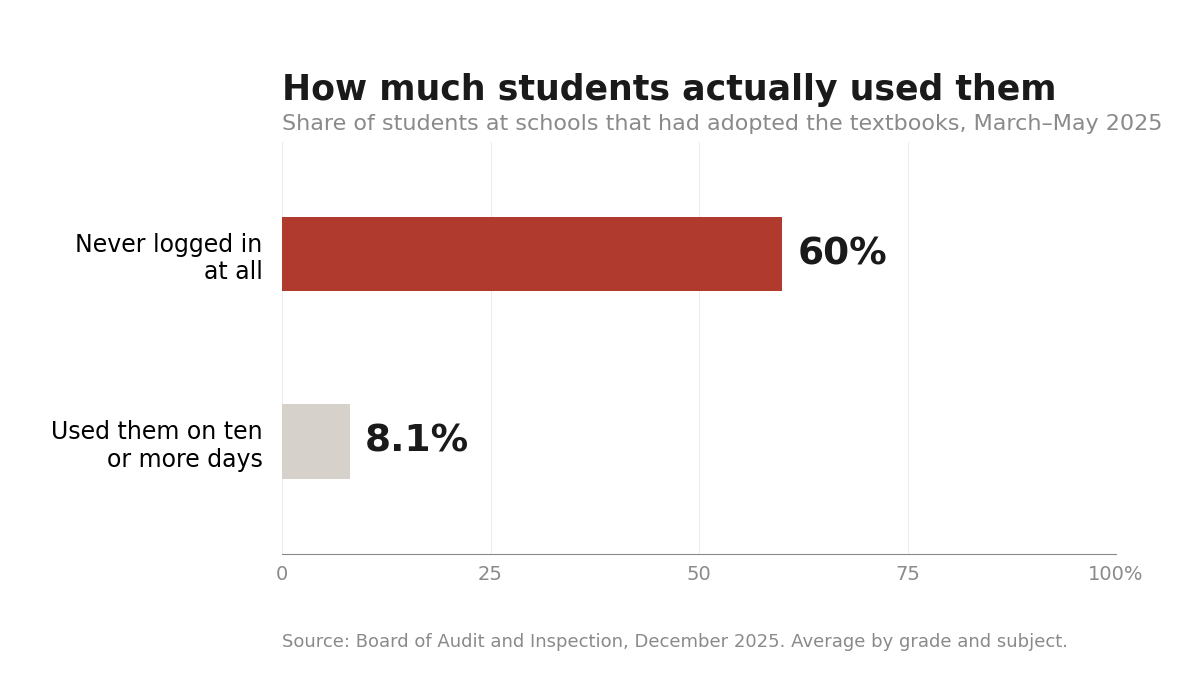
Actual use, however, was limited. The auditors examined usage logs from March to May 2025 at schools that had adopted the textbooks. On average, across grades and subjects, only 8.1 percent of students had used them on ten or more days. An average of 60 percent had never logged in at all.
And those numbers came from schools that had chosen to use them.
The promise was big
In 2023, the Ministry of Education announced its plan for AI digital textbooks. The rollout would begin in 2025 with English, math, and informatics in grades 3 and 4 of elementary school, the first year of middle school, and the first year of high school, then expand gradually to more grades and subjects.
The slogan was “personalized education for everyone.” Students would receive questions suited to their level, teachers would use student data to design lessons, and the time spent preparing lessons and assessing students would be reduced.
On paper, it sounded good. If it really worked that way, there would be little reason not to use it.
The problem was what happened next.
Within a year, it was no longer a textbook
In January 2025, as opposition grew, the rollout changed from something every school would use to something each school could choose.
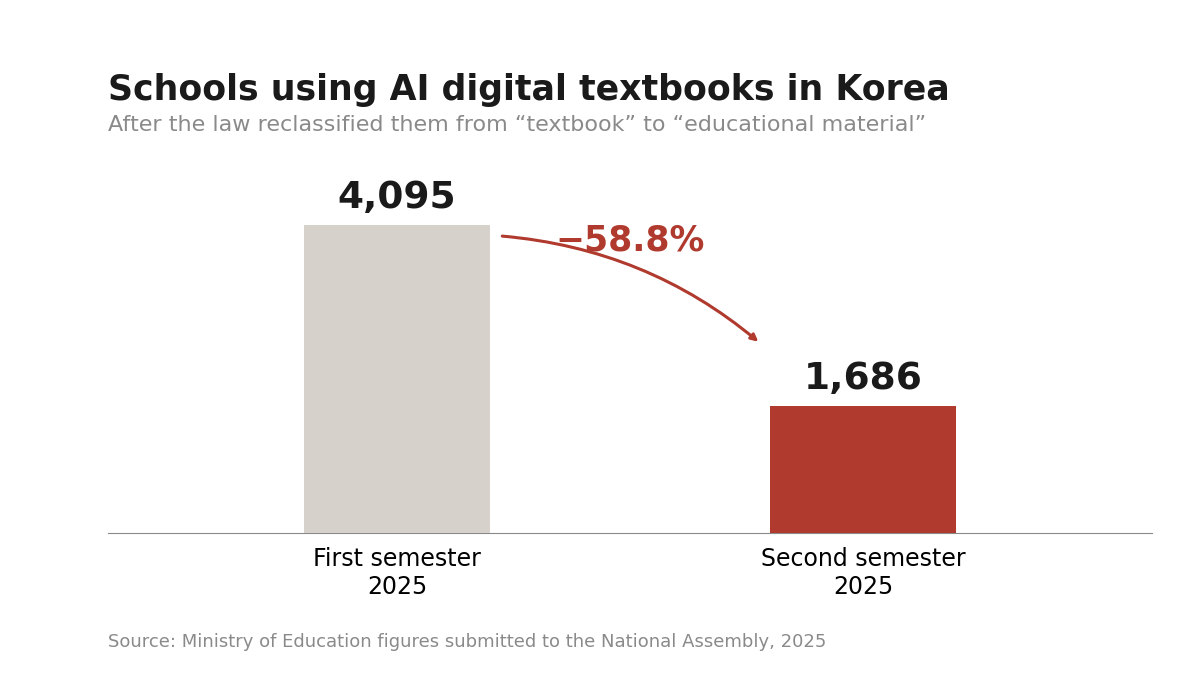
In the first semester, 4,095 schools adopted the textbooks, according to figures the Ministry submitted to the National Assembly.
In August, the law was amended, and AI digital textbooks were no longer legally classified as “textbooks.” They became “educational materials.”
That distinction matters in Korea. A textbook is something schools are expected to use. Educational material is something they can choose to use.
By the second semester, only 1,686 schools were using them. Compared with the same Ministry figures from the first semester, that was a 58.8 percent drop.
The December audit also looked at teacher use. Among teachers at schools that had selected AI digital textbooks, 85.5 percent had either never used them or had tried them and then stopped.
With the situation having reached this point, around ten publishers that had developed the textbooks sued the government in June 2026, seeking roughly 200 billion won in damages. Some other publishers stayed out of the joint lawsuit and were preparing or considering separate claims.
Announced in 2023. Introduced into schools in 2025. Stripped of textbook status that same year. In court the year after.
Teachers were not pushing back against AI
The reaction is sometimes described as teachers resisting new technology. That is not how it felt inside schools.
Korean teachers already use plenty of digital tools in the classroom. If a lesson calls for it, we use tools like Canva or Padlet. Nobody has to tell us to. If something helps the lesson, we use it. If it does not, we do not.
What frustrated teachers was not AI itself. It was the way it arrived.
The tools we already had were still not fully settled, and now there was another platform to manage. The paper textbooks did not disappear either.
From a teacher’s perspective, AI was not removing one task from the pile. It was adding another task on top.
“The things we already have don’t even work properly, and now another one is coming.”
That one sentence captured much of the frustration teachers were feeling.
A year later, the audit pointed to a similar problem. The Ministry had held briefings and forums, but there had been no formal process for gathering the views of the people who would actually use the system: students, parents, and teachers.
In schools, people had been saying this from the beginning.
What failed was the order, more than the AI
Foreign coverage has sometimes described this as South Korea’s “AI textbook failure.” I see it a little differently.
First, it moved too fast.
With a new piece of educational technology, you can start by trying it in a small number of schools. You check whether students actually use it, whether teachers find it helpful, and whether things like logging in work properly.
If something does not work, you fix it and try again. Then you scale it up.
This time, the textbooks intended for schools across the country were built first. A pilot that had originally been planned was dropped because there was not enough time, and the field-suitability review — using the system in real lessons and fixing problems as they appeared — was not properly carried out.
The audit made the same point: when introducing a new type of textbook, a pilot should first be used to test its effectiveness and identify problems.
This was not really a question of whether AI itself was good or bad.
It was a question of trying it before deciding.
The word “textbook” was too heavy
The AI digital textbook was not simply another program that teachers could use in class. It went through government authorization and was given the legal status of a textbook.
That distinction matters.
With an ordinary edtech tool, a teacher can try it and, if it does not work well, use something else. You cannot do that so easily with a textbook.
In other words, a technology that had not yet been fully tested in classrooms was given one of the heaviest possible roles from the beginning.
When problems appeared, the response was not simply to patch a few features. The law itself had to be amended to change its status from textbook to educational material.
If it had entered schools from the beginning as one tool among many, schools that found it useful could have continued using it, while others could simply have chosen something else.
Teachers were the users, not the makers
The people who would use the system every day were teachers, but teachers were not at the center of creating it.
We were the people who received the finished product and were expected to use it.
We were also told that it would reduce teachers’ workloads. But when a new platform enters a school, the workload usually goes up at first.
Teachers have to learn the interface, create student accounts, check devices, and help students who cannot log in.
If one or two students cannot log in after the lesson has started, the flow of the lesson stops right there.
In a school, small problems like that are much bigger than they sound.
A good feature and a good classroom tool are not the same thing.
The problems that become obvious within a single class period need to be considered while the tool is being built.
Where it stands now
AI digital textbooks have not completely disappeared. They are simply no longer textbooks designated by the state.
Schools can now choose learning-support software and other educational materials according to their needs. Teachers’ views are collected first, the product is checked against Ministry criteria, and the school governing committee reviews it. Data protection and educational value are also considered in the process.
A year ago, AI digital textbooks were supposed to become part of a national textbook system.
Now they are one of several tools a school can choose.
I think this arrangement makes more sense.
If something genuinely helps, teachers will use it without being forced to.
And this year, Korea started making “AI textbooks” again
There is a postscript to this story.
In 2026, the Ministry of Education began developing AI-related textbooks again.
These are different from the old AI digital textbooks.
This time, they are not textbooks that use AI to teach subjects such as math or English. They are textbooks for subjects in which artificial intelligence itself is what students study.
They cover 16 subjects across elementary, middle, and high school, and they are being written by serving classroom teachers.
And they are not being rolled out nationwide immediately.
They are scheduled for pilot use in the first semester of 2027, followed by reviews by provincial education offices for approved-textbook status. The plan is for schools to begin using them in March 2028.
The two projects have different purposes, so they cannot be compared directly.
Still, this time teachers are writing the textbooks, and the process begins with a pilot.
What I would take from this
None of this makes me think AI should stay out of schools.
I use AI myself, including in lessons when it is useful. Schools are going to use more AI in the future, not less.
I would just like us to start small.
Try it in a few schools first. See whether students keep using it. See whether teachers still want to use it after the novelty wears off.
There is no reason to call it a textbook on day one.
Let it enter the classroom as a supporting tool. If it proves useful and survives in real classrooms, then have the next conversation.
And ask the people who will actually use it first.
In the spring of 2025, teachers in Korean schools were not making some grand argument about AI.
They were saying something much simpler:
“The things we already have don’t even work properly, and now another one is coming.”
A year later, the national audit office concluded that user input had been insufficient and that the pilot had been skipped.
An enormous amount of public money had been spent before reaching that conclusion.
Putting the word “AI” on something does not change a school.
In a classroom, there is really only one question:
Does it actually help?
There is nothing too slow about answering that question first.
Sources
- Ministry of Education, “Plan for Promoting AI Digital Textbooks” (AI 디지털교과서 추진방안), June 8, 2023 — Korea Policy Briefing
- Etoday, “Veto on the bill downgrading AI textbooks: full rollout deferred a year, this year only for volunteering schools,” January 10, 2025
- Newsis, “Amendment to the Elementary and Secondary Education Act downgrading AI textbooks to educational material passes the National Assembly,” August 4, 2025
- Korea University Times, “AI digital textbooks downgraded to educational material: second-semester adoption down 60 percent,” from the 2025 National Assembly audit of government
- Board of Audit and Inspection, “Audit of the introduction of AI digital textbooks,” December 2025 — reported in The Korea Economic Daily
- Yonhap News, “AI digital textbooks introduced without any pilot: audit office finds ‘inadequate preparation,’” December 17, 2025
- Education Plus, “The audit office asked teachers: fewer than two in ten used the AI digital textbook,” December 2025
- Ministry of Education, “Criteria for schools selecting safe and effective learning-support software,” December 29, 2025
- The Korea Economic Daily, “We invested because we trusted the government: AIDT publishers file damages claims in the hundreds of billions of won,” June 25, 2026
- Ministry of Education, “AI subjects: teachers to lead, from classroom materials to approved textbooks” (인공지능(AI) 교과, 교원이 주도하여 교육자료부터 인정교과서까지 만든다), August 27, 2026 — reported by Newspim
- Rest of World, “South Korea’s AI textbooks fail after rushed rollout,” 2025