From Korea
South Korea Banned Phones in Class. Nobody Said Who Keeps Them.
In August 2025, the news went out that Korean schools were banning phones.
It got a fair amount of attention abroad. Several outlets picked it up, and American groups campaigning for school phone bans added Korea to their case files.
The law took effect on 1 March 2026.
As of October 2026, it has been running for about seven months.
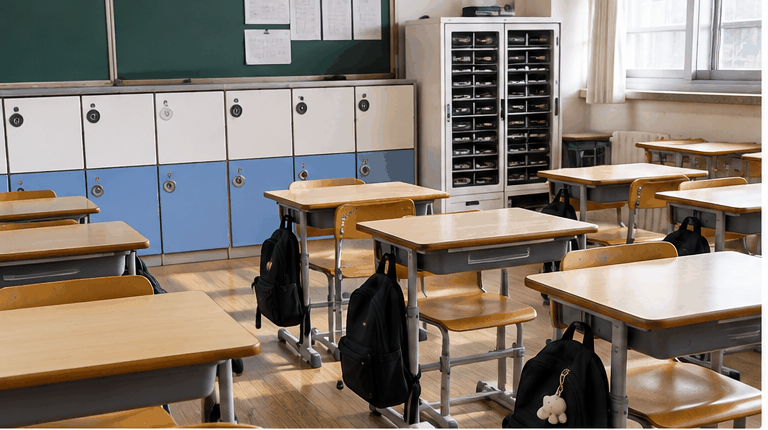
Photo 1. A Korean classroom with a phone storage cabinet at the back. Illustration generated with AI.
The law is simpler than you’d think
The law that changed is Article 20-5 of the Elementary and Secondary Education Act. It was newly inserted on 16 September 2025 and took effect on 1 March 2026. It runs to three clauses.
Clause 1. Students may not use smart devices such as mobile phones during class.
There are three exceptions: use as an assistive device by students with disabilities or special-education needs, use for educational purposes, and use to respond to an emergency. In those cases the principal and teachers may permit it.
Most coverage deals with Clause 1, because that is the headline — no phones during class. In an actual school, the next clause matters more.
Clause 2. The principal and teachers may, where necessary to protect students’ right to learn and teachers’ educational activities, restrict the use and the possession of smart devices on school grounds.
This is not only about use during class. The place is not “class time” but school grounds, and what can be restricted is not only use but possession. So if a school sets the standard, it can take phones in at the gate and hand them back at the end of the day.
Clause 3. When use or possession is restricted, the standards and methods, and which smart devices are covered, may be set in school rules.
The term “smart devices” matters here too. It does not mean phones only; tablets and other devices can fall under it.
And there is something quietly interesting in the wording.
It does not say the standards shall be set in school rules. It says they may be. Read the statute alone and writing it into the rules looks optional.
In practice, one more thing attached at the implementation stage. The Ministry of Education’s Notice on Teachers’ Guidance of Student Life, amended in February 2026, allowed schools that had not yet reflected the matter in their school rules to operate temporarily under rules set by the principal — but required them to put the content into their school rules by 31 August 2026.
So reading the statute and watching a school prepare to implement it give you slightly different pictures.
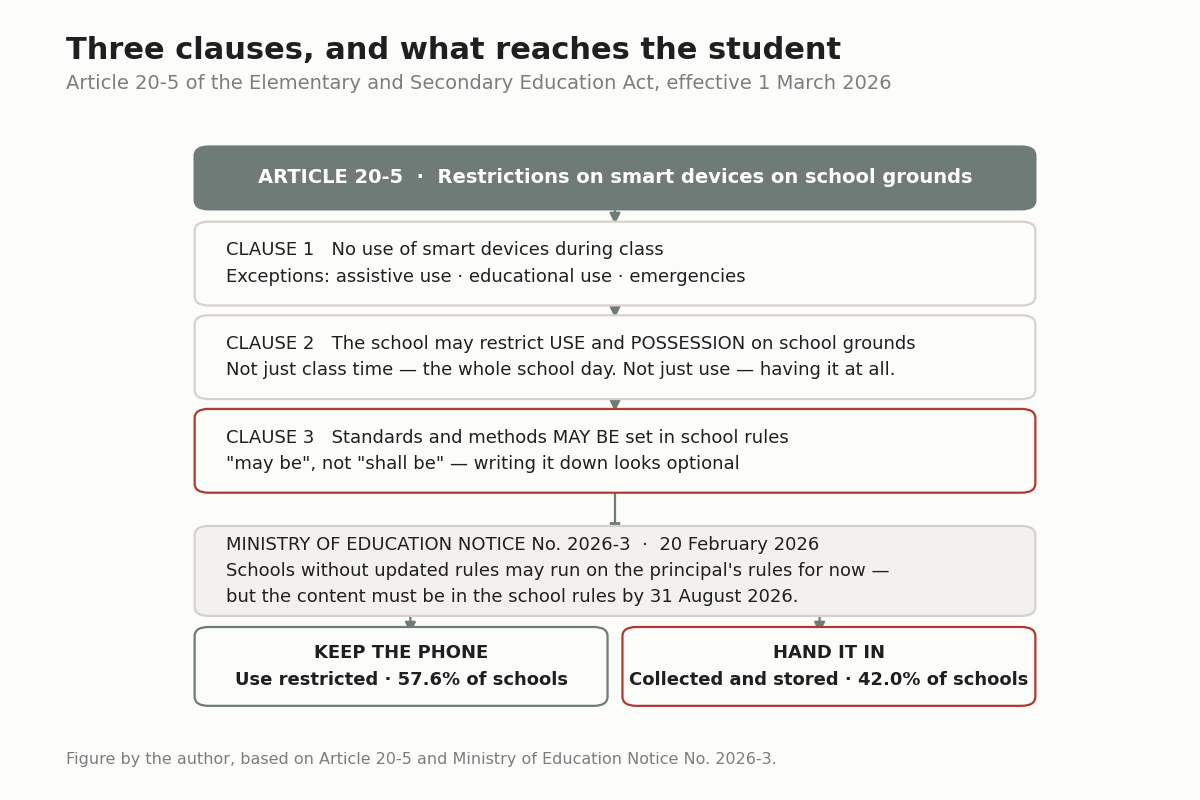
Figure 1. Korea’s school smartphone law: from classroom use to school-level rules. Author’s visualization, based on Article 20-5 of the Elementary and Secondary Education Act and Ministry of Education Notice No. 2026-3.
The statute and the school move a little differently
Under Clause 2, the people who may restrict the use and possession of smart devices are “the principal and teachers.”
Read the sentence on its own and it could sound as though any individual teacher may collect students’ phones on her own judgment.
Schools don’t usually work that way. A policy is set at the school level, and teachers apply that policy in their own classrooms. For a rule like phone collection, which applies to every student in the building, this is not the sort of thing one teacher decides alone.
At national and public schools, enacting and amending school rules is a matter for deliberation by the school operating committee. At private schools, it is advisory.
So the law is a few lines, but a school has to gather opinions, write the rule, and then apply it to actual students.
The decision happens at the level of the school. The person who meets the students every day and applies the rule is the teacher.
This is where the distance between the law and the classroom opens up.
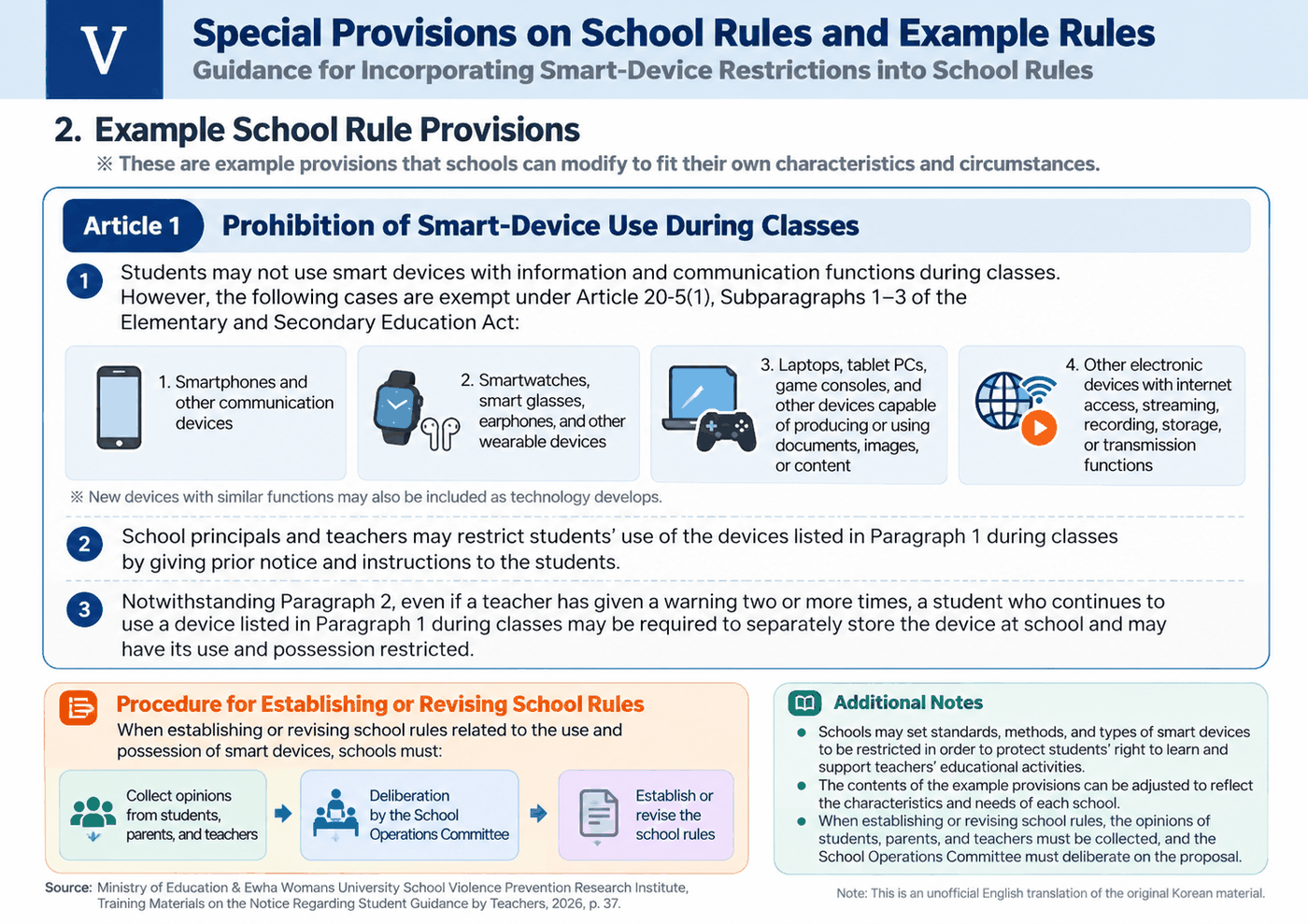
Document 1. School rules for smart-device restrictions. Source: Ministry of Education & Ewha Womans University School Violence Prevention Research Institute, Student Guidance Notice Training Materials, 2026, p. 37. Translated and adapted from the original Korean by the author.
Five months in, schools were all over the place
There is data as of 31 July 2026.
Of 11,868 elementary, middle and high schools nationwide, 9,879 — 83.2 percent — had reflected the smart-device restrictions in their school rules.
The more interesting part is how much the schools that had written rules differed from one another.
Of those 9,879, 5,688 schools (57.6 percent) chose to let students carry their phones while restricting when they may be used. 4,145 schools (42.0 percent) chose to collect phones at the gate and return them after regular classes or after-school activities ended.
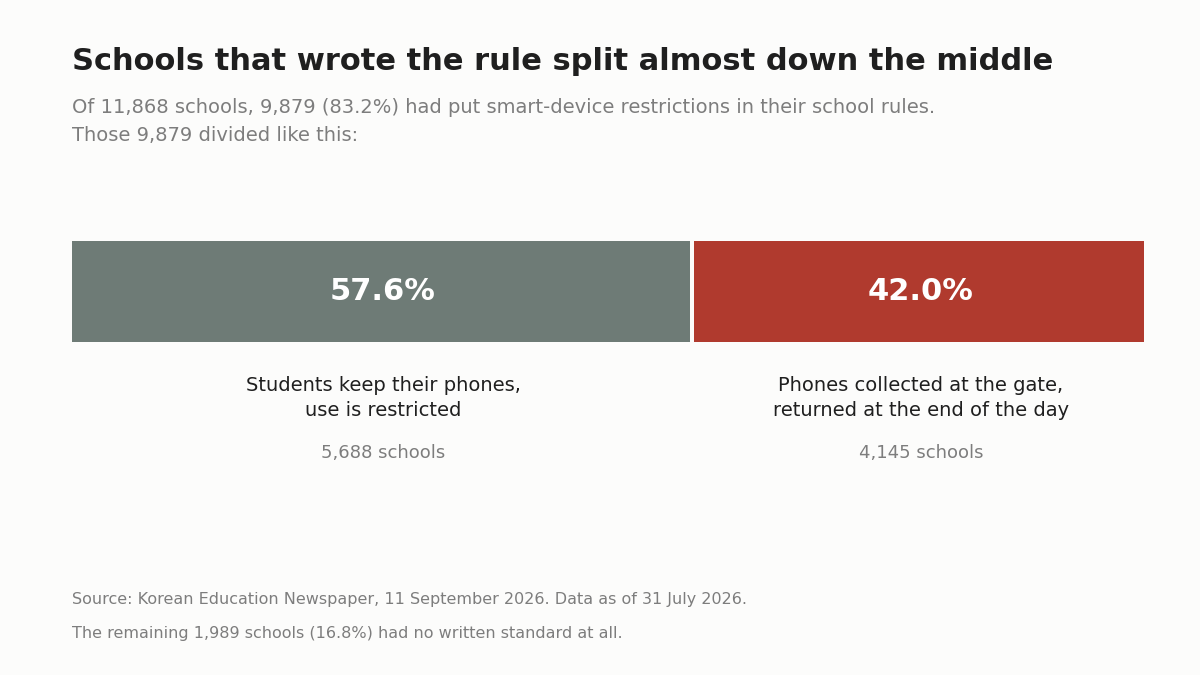
Figure 2. How schools implemented the new smartphone rules. Author’s visualization, based on Korean Education Newspaper, “Six Months After Phone Restrictions, Schools Take Different Approaches,” 11 September 2026. Data as of 31 July 2026.
By region the gap is wider.
In Busan 57.1 percent of schools separated and stored phones, and in Jeju 54.5 percent. In Jeollabuk-do it was 15.6 percent. Busan and Jeollabuk-do differ by roughly 3.6 times. In Gangwon-do, 69.3 percent allowed students to keep their phones.
Seoul did not settle on one approach either. Some schools let students keep their phones and barred use during class only. Some extended the restriction through breaks and lunch. Some collected at the gate and returned phones after regular classes. Some held them until after-school activities finished.
Same country, same law. One student carries a phone in his bag all day; another hands it in the moment he arrives.
Elementary schools look different again
Break it down by school level and the gap grows.
86.9 percent of middle schools collect phones at the gate. 65.7 percent of high schools collect.
Elementary schools are the reverse. 9.4 percent collect.
Instead, 65.4 percent let students keep their phones but bar use during breaks and lunch as well as class, and 24.6 percent restrict use during class only.
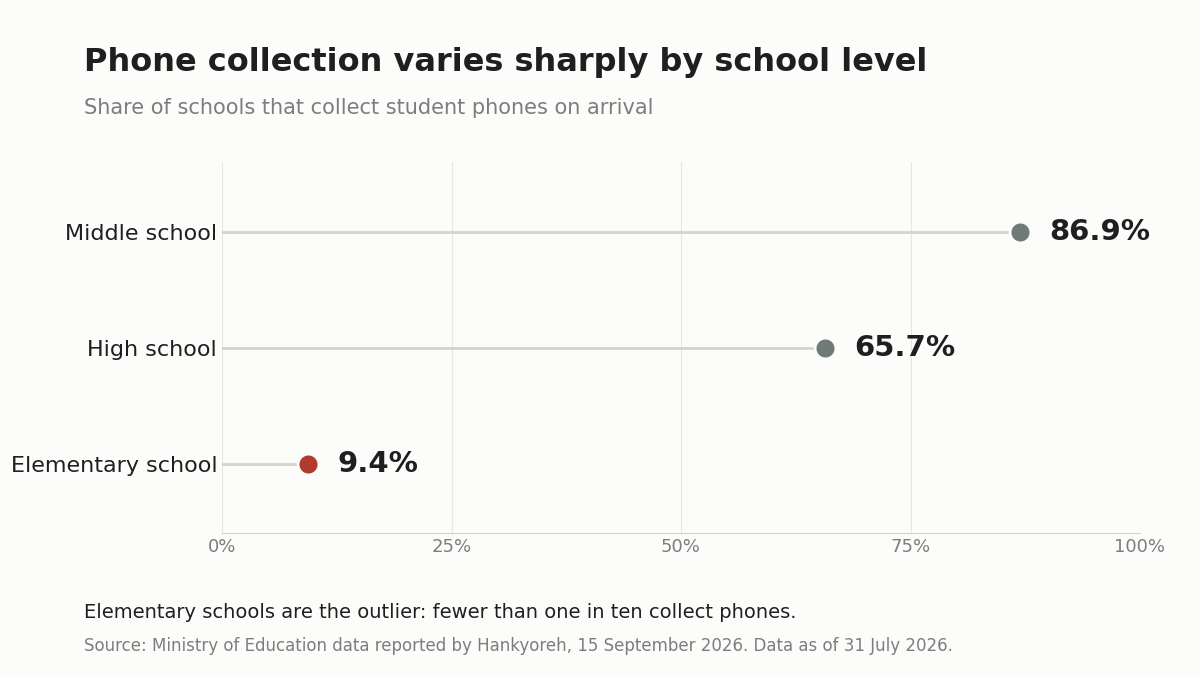
Figure 3. Phone collection varies sharply by school level. Author’s visualization, based on Hankyoreh, 15 September 2026. Data as of 31 July 2026.
So it is hard to say “Korean schools collect students’ phones” in a single sentence. In elementary schools especially, letting students keep them and restricting use is far more common.
There was a ten-year argument before this law
Korea has a National Human Rights Commission.
Since 2014, the Commission held that collecting students’ phones wholesale, or uniformly restricting their use inside a school, was a violation of students’ rights — an excessive restriction of their general freedom of action and their freedom of communication.
On 7 October 2024, that changed.
In a case where a high school collected students’ phones after they arrived and restricted their use, the Commission decided this did not constitute a rights violation. The decision was made public in April 2025. The Commission itself described it as changing its established precedent after more than a decade.
There is a further detail.
That same school had already received a recommendation from the Commission, in 2022, telling it to amend its student life regulations and stop uniformly restricting students’ possession and use of phones and other electronic devices until the end of the school day.
So on much the same phone rule at the same school, the Commission’s judgment moved in the space of two years.
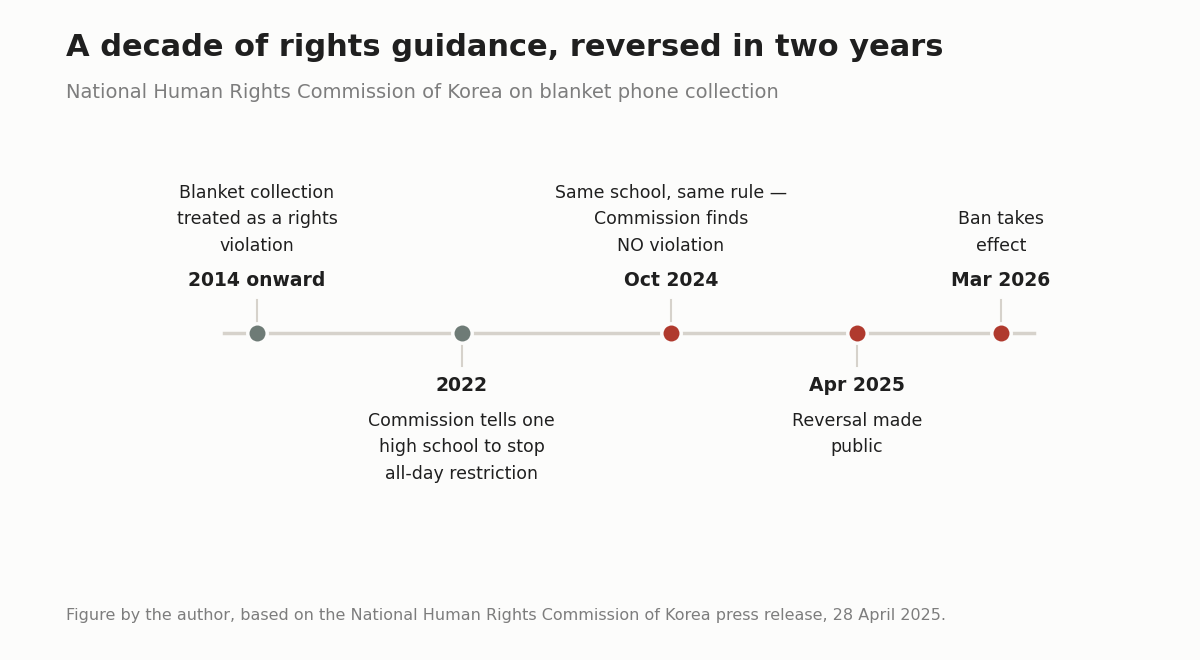
Figure 4. A decade of changing rights guidance on school phone collection. Author’s visualization, based on the National Human Rights Commission of Korea press release, 28 April 2025.
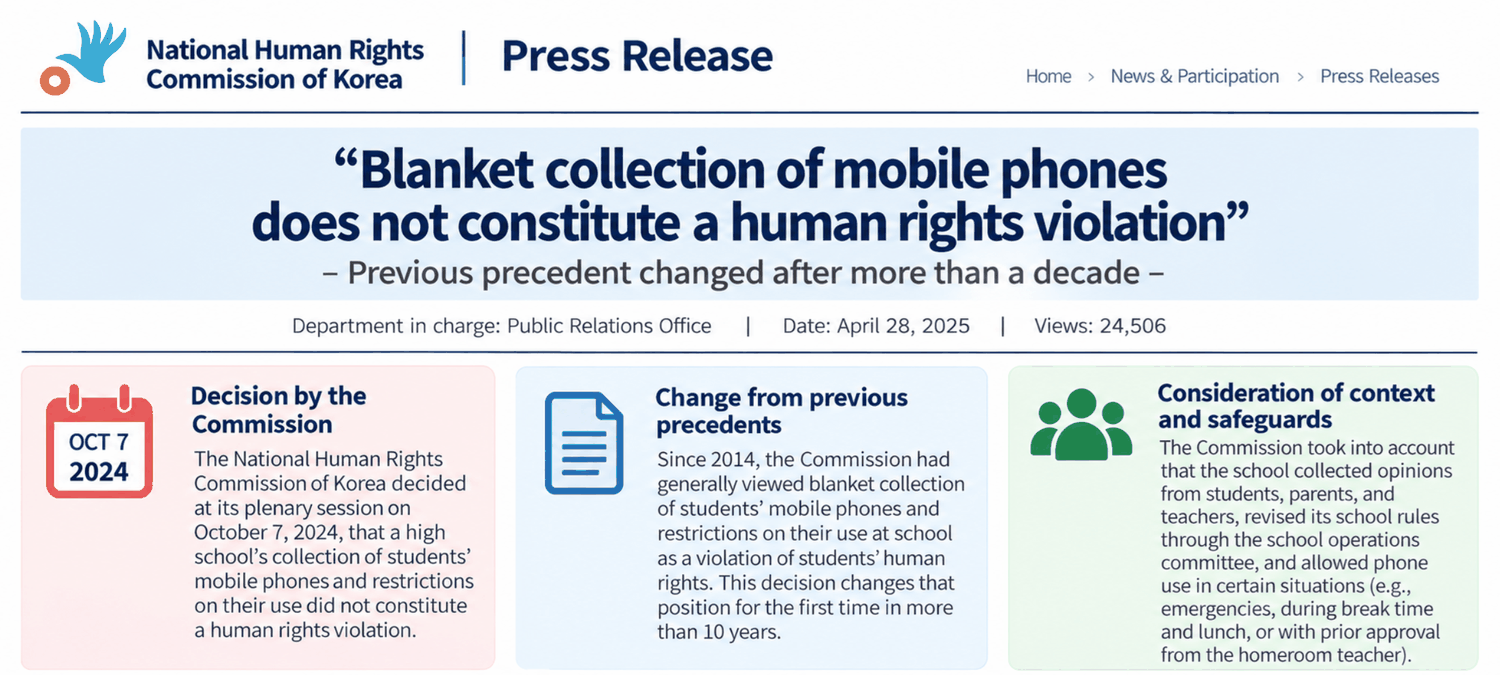
Document 2. Source: National Human Rights Commission of Korea, “Blanket Collection of Mobile Phones Does Not Constitute a Human Rights Violation — Previous Precedent Changed After More Than a Decade,” press release, 28 April 2025 (in Korean). Translated and adapted by the author.
The reason the Commission gave was that the environment around smartphones in schools had changed — that cyberbullying, exposure to harmful content and smartphone dependency had grown into larger problems than before.
And after that shift in position, in 2025, the National Assembly made the law that bans smart-device use during class.
On the ground, different problems appear
The moment you collect, the school becomes a custodian
Collecting a phone isn’t the end of it. From that point you have to keep it.
Put thirty students’ phones in one place and you may have tens of thousands of dollars’ worth of personal property sitting in the corner of a classroom. What happens if someone drops one. What happens if one goes missing. What happens if a student handed in a cracked screen to begin with. What follows the collection can be more complicated than the collection.
In November 2025, a fire broke out in a classroom at a high school in Anseong, Gyeonggi Province. It started in the place where students’ phones were being kept. About twenty phones stored there were destroyed, and investigators looked into the possibility that it began with a phone or power bank battery. Nobody was hurt; the students were out of the building that morning.
That fire happened nearly four months before the law took effect, at a school that had chosen to collect phones on its own. Collecting was already routine in Korean secondary schools, law or no law. What the law did, from March 2026, was push that routine onto many more schools at once.
The moment you collect, this becomes the school’s problem too.
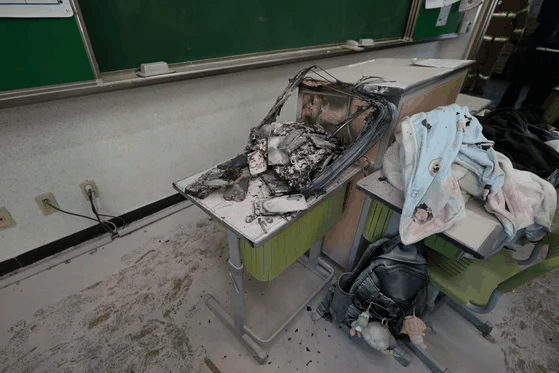
Photo 2. Damage after a fire in the phone storage box in a classroom at a high school in Anseong, 10 November 2025. Photo: Gyeonggi Provincial Fire and Disaster Headquarters.
Collecting is itself student guidance
If a student hands the phone over, nothing happens. If he doesn’t, it’s a different story.
You have to find out why he didn’t. You have to ask again. If he still won’t, you have to judge how far to take it. A complaint may come in that a collected phone went missing. There may be a conversation about whether the screen was already cracked or whether it cracked while the school was holding it.
In a policy document, “phones are collected” is one line. In an actual classroom, a person has to ask another person to hand over their phone. And the person doing that is the teacher.
And then the second phone appeared
Hand in an old handset you never use; keep the one you actually use. Cases are already turning up in schools.
At this point, running one rule requires a second round of enforcement. It is no longer enough to check that a phone was handed in. Now you have to check whether the real phone was handed in.
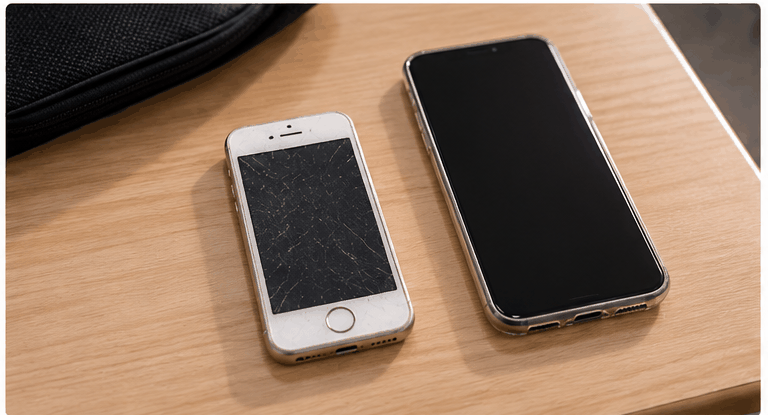
Figure 5. The “second phone” workaround. Illustration generated with AI.
In my classroom, we don’t collect
My rule is simple.
You don’t take your phone out while you’re at school.
Leaving it in the bag is fine. If a parent needs to reach their child urgently, they contact me, and I pass it on. I block the use during class that the law prohibits; I just don’t use the approach where the teacher holds the phone all day.
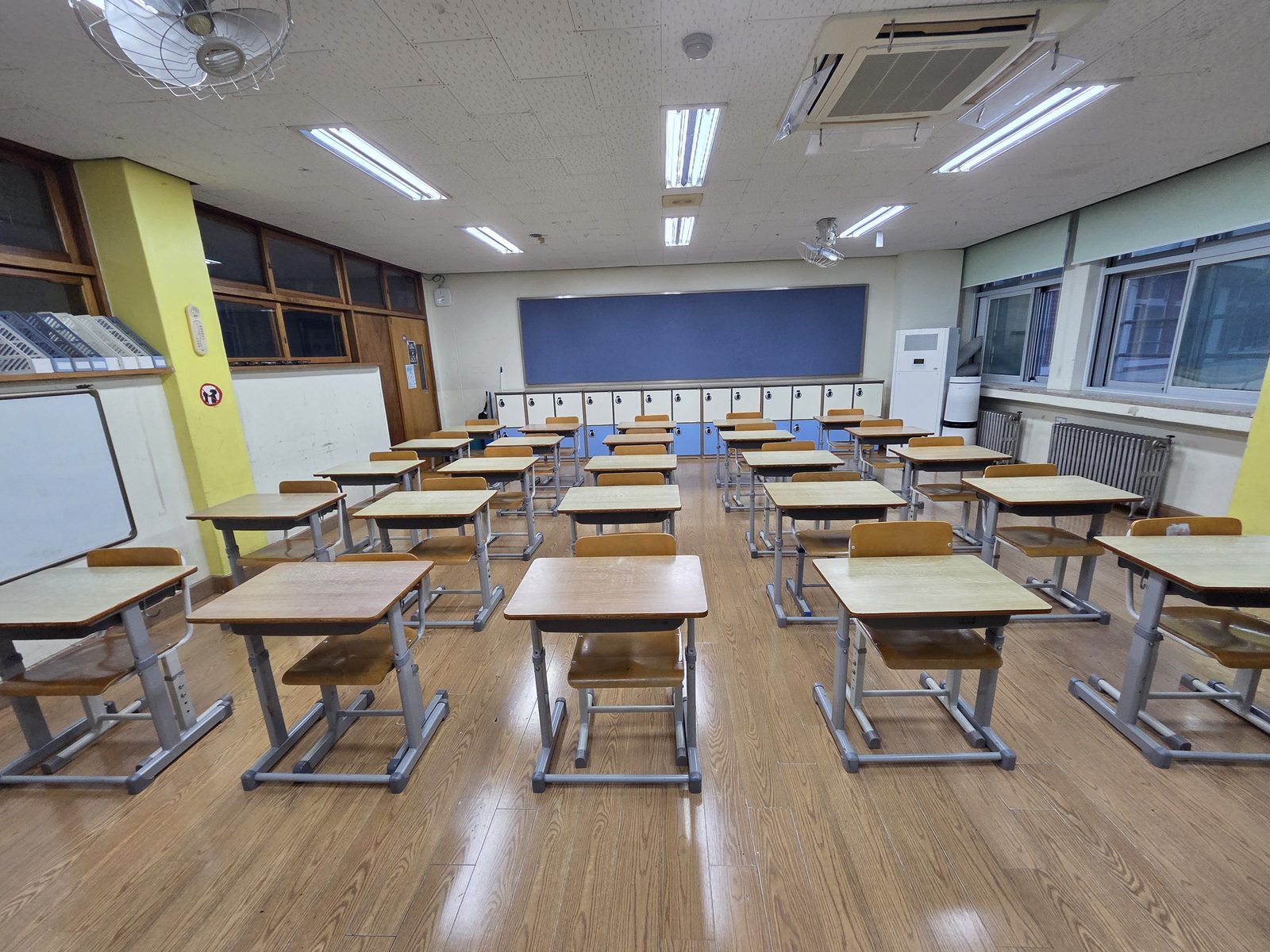
Photo 3. An elementary school classroom. Photo by the author.
By elementary school statistics, this isn’t a rare approach. Nationwide, 9.4 percent of elementary schools collect phones at the gate; most allow students to keep them and restrict when they can be used.
I think it fits elementary school well. We don’t collect, so there’s no need for a storage cabinet. No counting thirty phones in each morning. No handing thirty back out one at a time at the end of the day. No argument about who dropped what. No pile of thirty phones in the corner of the room.
It isn’t all upside. Parents can’t reach their child directly during the day, so sometimes the call comes to me instead. That is one more job for the teacher. I still think it beats taking custody of thirty phones.
In elementary school in particular, students rarely need to use a personal phone during class in the first place. So the point where schools actually diverge is closer to Clause 2 than Clause 1.
Let them keep it, or take it in.
What’s worth taking from Korea isn’t only whether to ban
I’m not trying to settle here whether schools should ban phones. That argument has plenty of room already. What interests me more in the Korean case is what comes after.
Deciding on a ban and operating one are different problems.
The law banned smart-device use during class. It let schools restrict use and possession on school grounds where necessary. That much is simple.
Then it reaches an actual school and the questions multiply. How far do we restrict. Do we restrict during breaks. Do students keep them. If we collect, where do we store them. Who manages that. What happens if one is lost or broken. What happens if a student won’t hand it over. And where do we write the standard down.
A few lines of statute do not settle this. And there is one question I think is worth asking before the others.
Do we have to collect at all?
Restricting use and taking custody of a student’s property are not the same act. If you can restrict use without collecting, the problem of liability for storage never comes into existence.
That is how my classroom runs. And most elementary schools in Korea have taken the same approach — students keep their phones, and use is restricted.
This doesn’t mean it works everywhere. In a school where students pull phones out every break and a teacher spends the whole day arguing about it, taking them in at the gate may simply be easier to run.
But the two approaches cost different things. If you don’t collect, you have to guide students on use. If you collect, that guidance may shrink — and in that moment the school becomes a place that stores students’ phones.
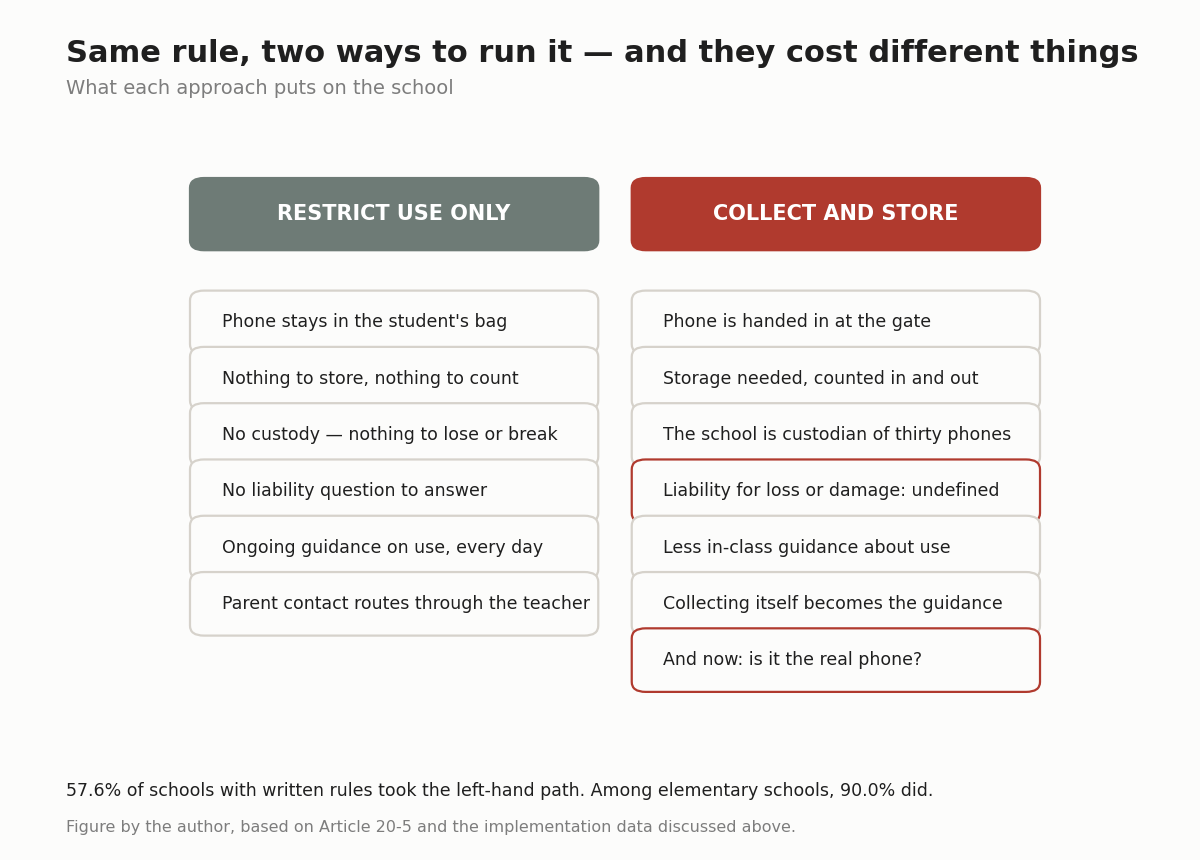
Figure 6. Two ways to enforce the same smartphone rule. Author’s visualization, based on Article 20-5 and the implementation cases discussed above.
Korea is currently producing a different answer at every school, somewhere between those two. If there’s a country or a district preparing phone restrictions, I’d want them to settle the next question as deliberately as the first.
How far the restriction goes. If phones are collected, who manages them and who is liable. And through what procedure the standard gets written down.
What’s interesting about the Korean case isn’t that a law banned phones. A law takes a few lines to write.
The hard part begins after the law arrives in the classroom.
Restricting use and storing a student’s property are not the same policy.
And a law can decide on a ban, but it does not decide who operates that ban every day, or what it costs them.
Sources
- Elementary and Secondary Education Act, Article 20-5 (Restrictions on the use of smart devices on school grounds), newly inserted 16 September 2025, effective 1 March 2026
- Elementary and Secondary Education Act, Article 32, Clause 1 (Functions of the school operating committee)
- Ministry of Education, Notice on Teachers’ Guidance of Student Life, Notice No. 2026-3, 20 February 2026
- Korean Education Newspaper, “Six Months After Phone Restrictions, Schools Take Different Approaches,” 11 September 2026
- Hankyoreh, “Phones Collected at the Gate at 87% of Middle Schools, 9% of Elementary Schools,” 15 September 2026
- National Human Rights Commission of Korea, “Blanket Collection of Mobile Phones Does Not Constitute a Human Rights Violation — Previous Precedent Changed After More Than a Decade,” 28 April 2025
- Newspim, “Fire in a Phone Storage Box in a Classroom at an Anseong High School — No Casualties,” 10 November 2025
- The Korea Herald, “Phones Banned in Class Starting March 2026”